
What Raw Materials Are Used in EPE Foam Manufacturing? A Practical Buyer’s Guide
Introduction
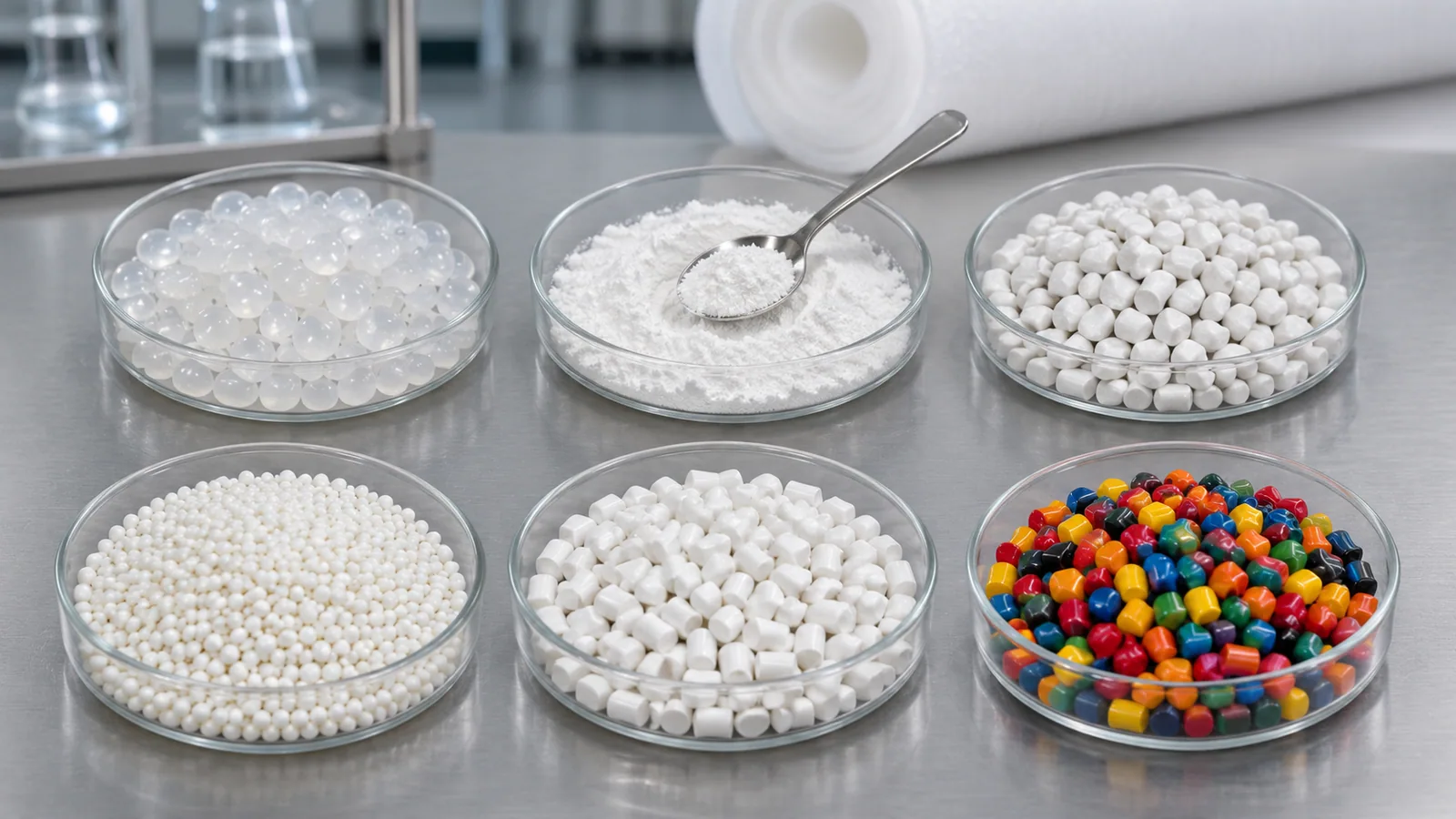
EPE foam is not defined by one pellet, additive, or universal recipe. It is the result of a material system, an extrusion process, and a finished-product target working together. For a typical non-crosslinked expanded polyethylene line, that system begins with a suitable polyethylene resin—commonly LDPE—and may include a physical foaming agent, a cell stabilizer such as glycerol monostearate (GMS), a nucleating aid such as talc or a talc masterbatch, and functional masterbatches for color, antistatic behavior, or flame performance.
That short list answers the basic question, but it is not enough to approve a purchase. Two materials with similar product names can differ in flow behavior, carrier resin, concentration, dispersion, regulatory status, or batch documentation. The effect also depends on the extruder, die, cooling conditions, ambient environment, storage time, and the target foam structure.
This guide explains what each material does, what it does not prove, and how an overseas buyer can move from an online description to a controlled factory trial and shipment specification.
Short answer: The main EPE foam raw material is usually a compatible polyethylene resin, commonly LDPE. A production system may also use a physical foaming agent, GMS or another cell stabilizer, talc or a nucleating masterbatch, and optional functional masterbatches. The final formulation must be validated on the buyer’s line because finished-foam behavior cannot be predicted from one datasheet value alone.
Start with the finished EPE product
Before comparing grades, define what the line must produce. “EPE foam” can describe rolls, sheets, fruit nets, tubes, profiles, laminated structures, protective inserts, or converted packaging. Those products do not impose identical requirements.
A useful purchasing brief should state:
- finished form: roll, sheet, net, tube, profile, or converted part;
- target thickness and density range;
- width, winding, lamination, printing, or bonding requirements;
- expected cushioning, flexibility, recovery, appearance, or color;
- electrical requirement, if any;
- flame-test requirement, if any;
- food-contact or other regulatory context, if applicable;
- current resin and additive grades;
- known processing limits and the defect being investigated.
The buyer should also describe how success will be measured. A visually acceptable roll at the die may still change during cooling, storage, conversion, or transport. Record dimensions and appearance at defined times instead of approving a material from the first few minutes of production.
The core EPE foam material system
1. LDPE or another compatible polyethylene base resin
LDPE is widely used as the base resin in non-crosslinked polyethylene foam extrusion because its processing behavior can be suitable for creating and stabilizing a cellular structure. However, the word “LDPE” is a family description, not an EPE approval.
Buyers commonly compare melt mass-flow rate and density. These are important identity and processing indicators when they are reported with a test method and conditions. They do not independently describe melt strength, cell stability, foam density, or cushioning performance. The same nominal melt-flow value can appear on resins designed for different applications.
When reviewing an LDPE proposal, ask for:
- the exact manufacturer and grade designation;
- a current technical data sheet and safety data sheet;
- melt-flow value with temperature, load, and test method;
- resin density with test method and specimen preparation;
- additive package information when commercially available;
- application guidance relevant to foam extrusion;
- batch or shipment document available for the supplied material;
- traceability and change-notification practice.
Do not copy a value from an unrelated film, coating, or molding grade and treat it as a universal foam window. Use the current grade as a baseline, compare one change at a time, and qualify the proposed resin on the actual line.
2. Physical foaming agent
In physically blown polyethylene foam extrusion, a blowing agent is introduced so that gas expansion creates the cellular structure. Industry references describe hydrocarbons such as butane or pentane, as well as gases such as carbon dioxide or nitrogen, depending on the equipment and process design.
This part of the process requires dedicated engineering and safety controls. A raw-material supplier should not replace the machine manufacturer, process engineer, local code authority, or safety professional. Storage, transfer, ventilation, gas detection, pressure control, hazardous-area classification, startup, shutdown, and emergency procedures must match the installed system and local regulations.
For purchasing content, the responsible message is simple: the foaming agent is essential to the physical process, but its selection and operating conditions are equipment- and safety-specific. Do not publish a generic dosage as operating advice.
3. GMS or another cell-stabilizing additive
Glycerol monostearate is commonly discussed in EPE production as a cell stabilizer or anti-shrinkage additive. It can influence how the cellular structure behaves after extrusion, but it does not eliminate every cause of dimensional change.
Shrinkage or instability may also relate to resin behavior, gas level, temperature profile, pressure, die condition, cooling, line speed, ambient conditions, product thickness, or the time at which the measurement is taken. That is why “use more GMS” is not a reliable diagnosis.
Compare GMS grades by more than a headline purity statement. Review identity, form, relevant composition information, storage guidance, handling information, batch consistency, and the evidence required for the intended market. If a supplier describes a grade as food grade, confirm what document supports that statement and remember that one ingredient description does not establish compliance of the finished foam or package.
A controlled GMS trial should keep the resin, other additives, line settings, target product, and measurement schedule as stable as practical. Record immediate foam quality and delayed dimensional behavior.
4. Talc or talc foaming masterbatch
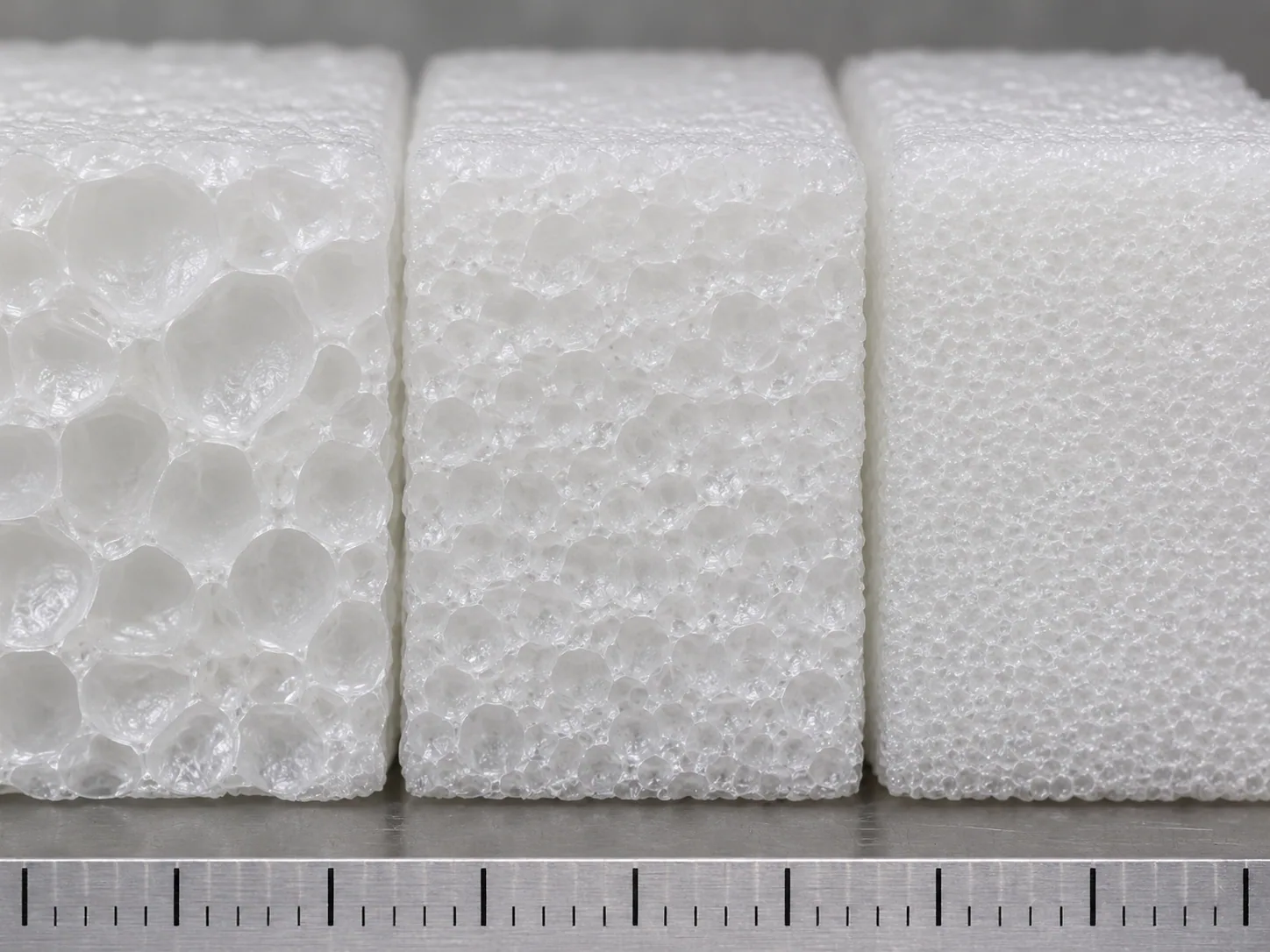
Talc can act as a nucleating aid in suitable foam formulations. Nucleation influences where cells begin to form, so dispersion, particle characteristics, carrier compatibility, and processing conditions can affect cell structure and surface appearance.
Loose powder and a pelletized talc masterbatch are not identical purchasing options. A masterbatch can simplify feeding and reduce loose-powder handling, but it introduces a carrier resin and a concentration that must fit the formulation. Buyers should confirm:
- carrier resin and compatibility with the base resin;
- stated active or mineral content and how it is measured;
- particle or dispersion information available from the supplier;
- pellet quality and feeding behavior;
- moisture, storage, and handling guidance;
- recommended starting trial range—not a guaranteed universal dosage;
- batch document and inspection method.
The result should be judged in finished foam: cell distribution, surface, stability, mechanical behavior, output, waste, and downstream conversion.
Optional functional masterbatches
Color masterbatch
Color masterbatch provides pigment or dye in a polymer carrier. A visual color match is necessary, but production approval also depends on dispersion, opacity, migration or rub-off concerns, thermal stability, carrier compatibility, and any application-specific compliance requirement.
Request a physical color reference or an agreed color system, but approve the color in representative finished foam under controlled lighting. The same masterbatch can look different when foam density, thickness, cell structure, or surface texture changes.
Antistatic masterbatch
An antistatic masterbatch is used when the application requires lower charging behavior or another defined electrical outcome. “Antistatic,” “dissipative,” “conductive,” and “discharge shielding” are not interchangeable terms.
The inquiry should name the required finished-material property, measurement method, conditioning, acceptable range, service period, and use environment. The EOS/ESD Association notes that low charging is not necessarily predicted by resistance alone. Therefore, neither pink color nor a masterbatch datasheet proves protection for a sensitive electronic device.
Test the finished foam and, where relevant, the assembled package.
Flame-retardant masterbatch
A flame-retardant masterbatch may be considered when a finished product must meet a defined flammability requirement. The first question is not “What dosage passes?” It is “Which test method, specimen thickness, conditioning, classification, and end-use requirement applies?”
UL 94, for example, includes classifications for low-density foam materials as well as different classifications for solid plastics and thin materials. They are not automatically equivalent. A supplier’s additive description cannot certify the buyer’s finished foam, and a small internal flame check cannot replace required third-party testing.
Qualify the complete formulation and representative specimen through the appropriate test route.
How the materials interact
The components should not be approved as isolated catalogue items. A resin change can alter process response. A carrier resin can influence compatibility. A pigment or flame-retardant package can affect appearance, flow, cell structure, or mechanical behavior. A change in foam density can alter the visual result and the specimen used for electrical or flame testing.
This creates a practical rule for buyers:
Approve a material system for a defined product and process window, not a collection of unrelated datasheets.
Build a formulation record that identifies the exact grade and batch of each component used in the approved trial. Record the machine, product, important settings, ambient conditions, output observations, and test results. The record becomes the baseline for receiving inspection and future troubleshooting.
A factory-trial workflow buyers can use
Step 1: Establish the current baseline
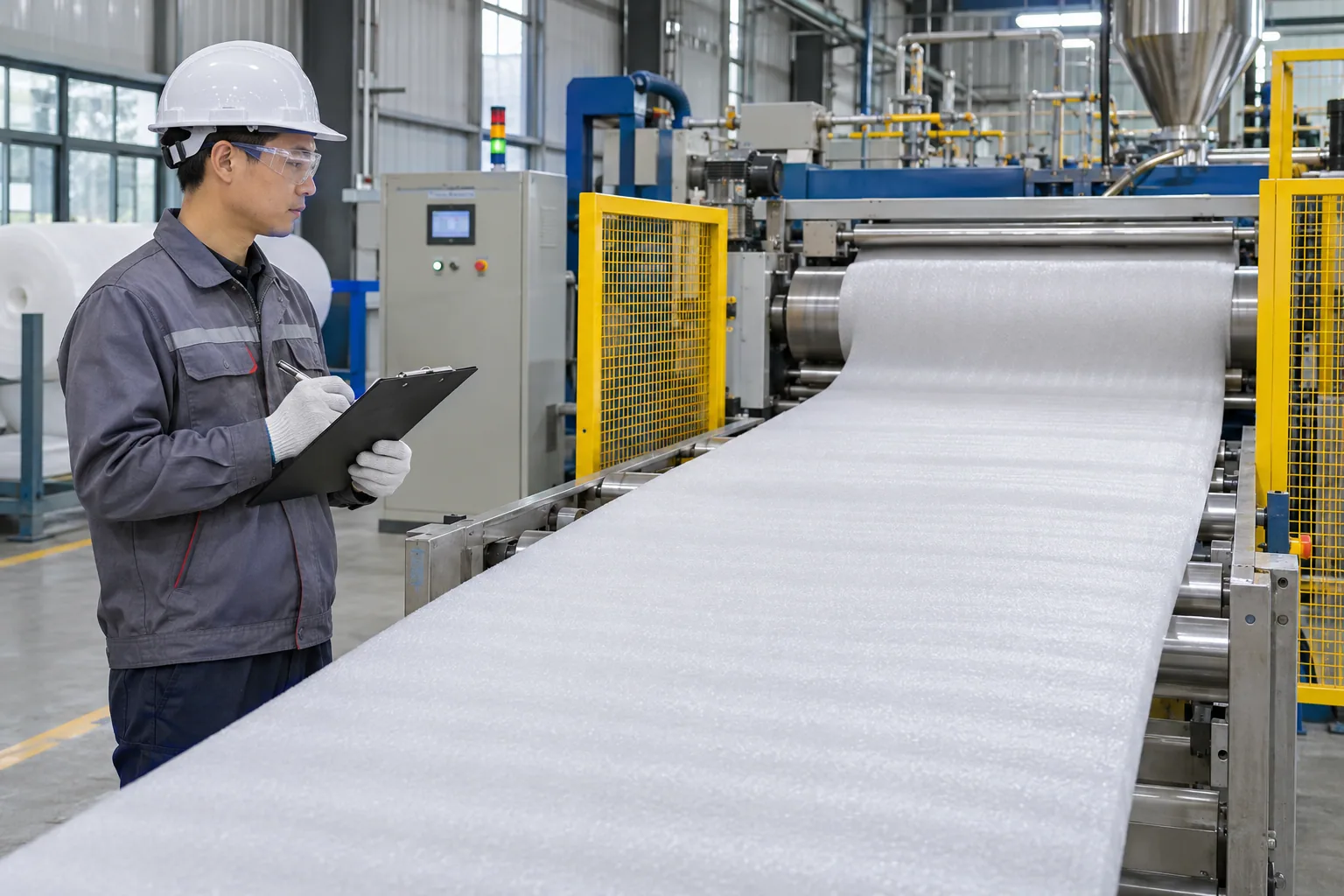
Run or document an accepted production condition using the current materials. Record output, scrap, cell appearance, dimensions, winding, and delayed stability. Without a baseline, a trial can show that production changed but not whether the proposed material improved it.
Step 2: Define one purchasing decision
A trial should answer a question such as:
- Can the proposed LDPE produce the accepted roll within the current operating window?
- Does the proposed GMS reduce the defined dimensional change without causing another defect?
- Can the talc masterbatch deliver acceptable cell structure and feeding behavior?
- Does the antistatic formulation meet the finished-foam electrical requirement after conditioning?
Avoid changing resin, additive package, die setup, and target density at the same time unless the goal is to qualify a completely new system and the trial plan accounts for that complexity.
Step 3: Confirm sample identity
The sample label, quotation, technical document, and later commercial shipment should use the same grade identity. Record the sample batch where possible. A successful anonymous sample is difficult to convert into a controlled purchase.
Step 4: Run long enough to reach a stable condition
Do not approve from the startup transition. Allow the previous material to clear and the line to reach the planned condition. Define who can adjust settings, what will be recorded, and what causes a stop.
Step 5: Evaluate downstream behavior
Inspect more than the extrusion surface. Follow the material through cooling, winding, storage, cutting, bonding, lamination, printing, or assembly as applicable. Recheck dimensions and properties at agreed times.
Step 6: Record the conclusion
Classify the result as approved, conditionally approved, rejected, or requiring another trial. Note the approved application, restrictions, document revision, and any required incoming checks.
Mid-article CTA: Send Your Production Requirements
Selecting an EPE material system starts with the product, line, and target property—not a generic recipe. Send FULL TECH your current resin and additives, finished product, trial quantity, destination, and the problem you want to solve. We can organize the requirement for a grade and document review before you commit to a larger order.
From approved trial to shipment specification
The commercial order should preserve the technical identity that passed the trial. A purchase specification can include:

- exact product and grade name;
- manufacturer or approved source, when required;
- packaging format and net weight;
- batch or lot identification;
- required TDS, SDS, COA, or other agreed documents;
- agreed inspection items and acceptance rules;
- label language and shipping marks;
- storage and transport requirements from current documentation;
- change-notification expectation;
- reference to the approved sample or trial record.
For shipment inspection, verify quantity, packaging integrity, labels, grade, batch identification, pallet condition, and document consistency before loading where the agreed inspection scope allows. Photographs can document condition, but they do not replace sampling or testing.
At receiving, quarantine damaged or unidentified material. Match labels and documents to the purchase order before feeding the line. Keep retain samples when the risk and value justify them. If performance changes, compare the suspect batch with the approved record instead of relying on memory.
Common purchasing mistakes
Buying only by the lowest price per kilogram
The relevant cost is cost per accepted output. Scrap, unstable production, slower line speed, additional adjustment, claims, and delayed delivery can outweigh a small material-price difference.
Treating one number as the specification
Melt flow, density, purity, active content, resistance, or color difference can be useful, but each needs a method, condition, and decision context. No single number represents the whole material system.
Using a supplier’s finished-product claim without validation
“Suitable for EPE,” “antistatic,” or “flame retardant” is a starting description. Approval requires evidence for the exact grade and a trial or test on the buyer’s representative product.
Confusing documentation roles
A TDS describes typical or selected technical information. An SDS communicates hazards and safe handling. A COA or batch document reports agreed batch information. None automatically substitutes for the others.
Skipping change control
A change in manufacturer, grade, carrier, concentration, pigment, packaging, or production source may affect the approved result. Define which changes require notice and requalification.
Frequently Asked Questions
What is the main raw material for EPE foam?
For many non-crosslinked EPE extrusion processes, the main polymer is a suitable LDPE grade. The exact resin must be matched to the equipment, formulation, and finished product. “LDPE” alone is not a complete purchasing specification.
What does GMS do in EPE foam?
GMS is commonly used as a cell-stabilizing or anti-shrinkage additive. Its result depends on the formulation and process. It should be evaluated through a controlled trial with dimensions and foam quality checked at defined times.
Why is talc used in EPE foam production?
Talc can support nucleation in a suitable formulation, influencing cell formation. Dispersion, particle characteristics, carrier resin, feeding, and process conditions affect the result. Finished-foam evaluation is required.
Is a blowing agent an EPE raw material?
Yes, a physical foaming agent is part of physically blown EPE production. Its selection, storage, transfer, and operating conditions are equipment- and safety-specific and must follow professional engineering and local regulatory requirements.
Can one EPE formula work on every extrusion line?
No. Machine design, output, die, temperature and pressure control, cooling, product geometry, environment, and material grades differ. Use supplier guidance only as a trial starting point.
Does a masterbatch certificate guarantee finished-foam performance?
No. It can describe the masterbatch or report selected batch properties, but finished-foam performance depends on the complete formulation, process, specimen, conditioning, and test method.
What information should I send when requesting a quotation?
Send the product type, current material grades, target foam density and thickness, application, required property or test, estimated quantity, destination, packaging preference, and any defect or improvement target. Photos and current documents can help clarify the request.
Conclusion
EPE foam production uses a coordinated material system rather than a single universal ingredient. LDPE commonly provides the polymer base; a physical foaming agent creates expansion; GMS may support cell stability; talc may assist nucleation; and functional masterbatches can introduce color, electrical behavior, or flame performance.
The dependable buying process is to define the finished product, compare exact grade documents, run a controlled factory trial, test the representative foam, and convert the approved result into a traceable shipment specification. That approach is more useful than copying a formula from another line or approving a material from one headline value.
Final CTA: Review Your EPE Raw Material System
Preparing a new line, changing a grade, or investigating unstable foam? Send FULL TECH your application, current material list, target property, trial quantity, and destination. We will help structure the material inquiry and identify which grade documents and trial checks should be reviewed before shipment.
Technical References
- Entec Polymers, Polyolefin Foam Extrusion Overview — general overview of polyolefin resins, physical foaming agents, and cell stabilizers; suitability remains the user’s responsibility.
- ASTM International plastics resources — examples of named methods for polyethylene melt flow, density, ash, and color.
- EOS/ESD Association, Fundamentals of ESD, Part 3 — distinction between low charging, resistance behavior, and discharge shielding.
- UL Solutions, Combustion (Fire) Tests for Plastics — overview of UL 94 classifications, including classifications for low-density foam materials.
